

 |
| Complete Career Roadmap for Medical Transcriptionists, Medical Scribe, Clinical Scribe, Remote Scribe or virtual scribe in UAE & GCC Healthcare Facilities (DHA, DOH, MOHAP, SCFHS). |
How to Become a Medical Transcriptionist and Secure a Job in the Gulf
A Complete 2026 Career Guide to Training, Certification, Skills, Salaries, AI and Career Opportunities in the GCC
By Mohammad
Ali
Former Medical Secretary, Burjeel Medical City, Abu Dhabi, UAE

How to become a professional medical transcriptionist?
Introduction: The Person Behind the Patient Record< a>
Imagine a
physician finishing a long consultation.
The doctor has
examined the patient, reviewed laboratory results and imaging, discussed a
diagnosis and developed a treatment plan. Instead of sitting down for another
20 or 30 minutes to type everything, the physician dictates the encounter.
That voice
recording contains clinically important information.
Someone must turn
that information into an accurate, understandable and professionally formatted
medical document.
Traditionally,
that person was the medical transcriptionist.
But medical
transcription has changed dramatically.
The profession is
no longer simply about listening to an audio recording and typing words. Modern
healthcare documentation can involve electronic health records (EHRs),
speech-recognition software, digital dictation, automated documentation and
increasingly artificial intelligence (AI).
This
transformation has created both a challenge and an opportunity.
The challenge is
obvious: technology can automate a substantial portion of traditional
transcription.
The opportunity
is less obvious: healthcare organizations still need people who understand medical
language, clinical context, documentation quality, confidentiality, EHR workflows
and the difference between a plausible sentence and an accurate medical record.
The U.S. Bureau
of Labor Statistics currently projects a 5% decline in medical-transcriptionist
employment between 2024 and 2034. However, it still projects approximately
7,400 openings per year, largely because workers leave the occupation or
retire.
At the same time,
the broader health-information field is growing. BLS projects 15% employment
growth for health information technologists and medical registrars between 2024
and 2034, and 7% growth for medical records specialists.
For someone
planning a career in the Gulf, this distinction is extremely important.
The smartest
approach is not simply to train to become a typist.
It is to train to
become a healthcare documentation professional.
A modern Gulf hospital medical documentation department, with a professional
medical transcriptionist wearing a headset, working at a computer displaying an
electronic health record, physician dictation waveform on screen, subtle
Dubai/Abu Dhabi skyline in the background, realistic corporate healthcare
photography style.
 |
| Definition of a medical transcriptionist |
1. Who Is a Medical
Transcriptionist?
A
medical transcriptionist is a healthcare documentation professional who
converts dictated or recorded information from physicians and other healthcare
practitioners into accurate written medical documentation.
The
U.S. O*NET occupational profile describes medical transcriptionists as
professionals who transcribe reports involving office visits, emergency-room
encounters, diagnostic imaging, operations, chart reviews and final summaries.
They may also edit reports, expand abbreviations and return documents
electronically for review and signature.
Depending
on the employer, the professional may also be called:
·
Medical Transcriptionist
·
Clinical Medical
Transcriptionist
·
Healthcare Documentation
Specialist
·
Medical Language Specialist
·
Medical Transcription Editor
·
Documentation Specialist
·
Radiology Transcriptionist
·
Pathology Transcriptionist
·
Clinical Documentation
Specialist
The
terminology is changing because the profession itself is changing.
A
modern transcriptionist may spend less time producing a document completely
from scratch and more time reviewing, editing and validating documentation
generated through speech-recognition or AI-assisted systems.
 |
| Role and significance of a Medical Transcriptionist in healthcare |
2. What Does a Medical
Transcriptionist Actually Do?
A
typical medical transcriptionist may receive digital audio or electronic
dictation from physicians, surgeons, radiologists, pathologists, cardiologists
or other healthcare professionals.
The
professional listens carefully and converts the information into an appropriate
medical document.
Typical
documents include:
·
History and physical
examination reports
·
Consultation notes
·
Progress notes
·
Discharge summaries
·
Operative reports
·
Emergency-room reports
·
Radiology reports
·
Pathology reports
·
Cardiology reports
·
Procedure reports
·
Referral letters
·
Medical evaluations
·
Clinical summaries
·
Medicolegal reports
The
job normally involves much more than typing.
Listening
The transcriptionist must accurately understand
speech, sometimes involving different accents, speaking speeds, background
noise or poor audio quality.
Transcribing
The spoken information is converted into
written documentation.
Editing
The transcriptionist checks grammar, punctuation,
formatting and terminology.
Medical-language verification
Unfamiliar medical words,
drugs, procedures or abbreviations may need to be researched and
cross-referenced.
Quality control
The final document should be complete,
accurate, readable and consistent with the employer’s documentation standards.
EHR entry
In modern facilities, documentation may be
entered directly into an electronic health record.
O*NET emphasizes transcription, editing and
interpretation of medical terminology as core occupational activities.
 |
| Transcriptionist vs scribe vs medical secretary vs medical coder |
3. Why Is Medical Transcription Important to Healthcare?
It
is easy to underestimate medical transcription because much of the work happens
behind the scenes.
But
the medical record is one of the most important information resources in
healthcare.
A
patient’s record can contain information needed by:
·
Physicians
·
Nurses
·
Pharmacists
·
Surgeons
·
Allied health professionals
·
Insurance companies
·
Medical auditors
·
Hospital administrators
·
Researchers
·
Legal professionals
·
Patients themselves
An
inaccurate record can create confusion.
A
missing word, incorrect drug name, wrong anatomical term or misunderstood
procedure can potentially change the meaning of a clinical document.
This
is why documentation quality is closely connected to patient safety and
continuity of care.
The
professional therefore has a responsibility to preserve the meaning of the
clinician’s documentation, not simply to reproduce sounds.
The
goal is:
accurate
information + clear language + appropriate formatting + confidentiality.
 |
| Training, education and skill required to become a professional medical transcriptionist |
Related Healthcare & Licensing Guides
 Career Tools
Healthcare ATS CV Optimizer & Resume Builder
Create ATS-compliant medical resumes tailored for GCC healthcare recruitment and licensing standards.
 Expat Guide
UAE Cultural Awareness & Orientation for Healthcare Expats
Essential cultural competence, patient communication ethics, and workplace orientation for expat clinicians in the UAE.
 Medical Math
Professional Clinical Calculators for Healthcare
Access interactive medical math tools, dosage calculation suites, and unit convertors built for clinical practice.
 Employment
Understanding Medical Employment Contracts in the Gulf
Navigate UAE and GCC healthcare contracts, probation clauses, salary structure breakdowns, and legal rights.
4. Medical Transcriptionist vs Medical Scribe vs Medical Secretary vs Medical Coder
Related Healthcare & Licensing Guides
Healthcare ATS CV Optimizer & Resume Builder
Create ATS-compliant medical resumes tailored for GCC healthcare recruitment and licensing standards.
UAE Cultural Awareness & Orientation for Healthcare Expats
Essential cultural competence, patient communication ethics, and workplace orientation for expat clinicians in the UAE.
Professional Clinical Calculators for Healthcare
Access interactive medical math tools, dosage calculation suites, and unit convertors built for clinical practice.
Understanding Medical Employment Contracts in the Gulf
Navigate UAE and GCC healthcare contracts, probation clauses, salary structure breakdowns, and legal rights.
These
four occupations are often confused because they can all work around medical
records.
They
are, however, different professions.
|
Profession |
Primary
Function |
|
Medical
Transcriptionist |
Converts
dictated/recorded clinical information into written documentation and/or
edits automated documentation |
|
Medical
Scribe |
Documents
the clinician-patient encounter, usually in real time |
|
Medical
Secretary |
Provides
administrative and clerical support in a healthcare setting |
|
Medical
Coder |
Converts
documented diagnoses and procedures into standardized healthcare codes |
Medical Transcriptionist
The traditional workflow is:
Doctor’s voice → transcription
→ medical document
Increasingly:
AI/speech recognition → human
review → corrected medical document
Medical Scribe
A medical scribe generally works much
closer to the clinical encounter and documents what happens during the
consultation.
Medical Secretary
A medical secretary focuses primarily on
administrative functions such as scheduling, correspondence, records, telephone
communication and office coordination.
Medical Coder
A medical coder interprets clinical
documentation and assigns appropriate codes according to recognized coding
systems and guidelines.
Coding is a different professional
discipline and requires additional education.
IMAGE SUGGESTION #2 —
Four-panel realistic healthcare scene showing a medical transcriptionist at a
workstation, a medical scribe beside a physician, a medical secretary handling
hospital administration and a medical coder analyzing a coded medical record.
 |
| Authorized institutions offer certification courses for RHDS and CHDS |
5. What Education Does a
Medical Transcriptionist Need?
There
is no single universal educational requirement for every country.
In
the United States, BLS states that medical transcriptionists typically need
postsecondary education leading to a certificate and knowledge of medical
terminology, anatomy, physiology and grammar.
For
a person planning to work in the Gulf, a stronger educational profile can be
advantageous.
A
serious training program should include:
Medical terminology
The student must understand prefixes,
suffixes, word roots, abbreviations and clinical terminology.
Anatomy
The student needs to know body structures.
Physiology
The student should understand how body systems
function.
Pharmacology
Drug names are particularly important because
transcription errors can occur when similar-sounding medication names are
dictated.
Disease processes
Understanding common diseases helps a
transcriptionist recognize whether a phrase is clinically plausible.
Medical report formats
Different specialties produce
different types of documentation.
English grammar
The final report must be grammatically
correct without changing the clinician’s intended meaning.
Computer skills
The student should become proficient with:
·
Microsoft Word
·
Keyboard shortcuts
·
Digital dictation
·
Audio playback
·
Speech-recognition software
·
EHR/EMR systems
·
Document-management systems
Confidentiality
The professional must understand
healthcare privacy and information-security principles.
HIPAA Compliance for Medical Transcriptionists
HIPAA (Health Insurance Portability and Accountability Act) compliance is an essential professional responsibility for medical transcriptionists who handle protected health information (PHI), particularly when working with U.S. healthcare providers. A transcriptionist may have access to sensitive information such as patient names, diagnoses, medical histories, medications, laboratory results and treatment details. Such information must be accessed, used, stored and transmitted only for authorized professional purposes.
Medical transcriptionists should follow the minimum necessary principle, access only the records required for their work, use employer-approved computers and software, maintain strong passwords and authentication, secure their workspace, and never share patient information through personal email, social media, unauthorized cloud storage or consumer AI platforms. Remote transcriptionists must apply the same confidentiality and security standards when working from home.
When electronic protected health information (ePHI) is involved, appropriate administrative, physical and technical safeguards are essential. Any suspected unauthorized access, accidental disclosure, lost device or security incident should be reported immediately according to the employer's procedures.
For Gulf-based transcriptionists, HIPAA is particularly relevant when working remotely or through outsourcing arrangements for U.S. healthcare organizations. Even when HIPAA does not directly apply, local healthcare privacy and cybersecurity laws must be followed.
HIPAA compliance ultimately protects patient privacy, maintains trust and preserves the integrity of healthcare records.
 |
| Role of Association of healthcare documentation integrity (AHDI) |
6. Does the Job Require
Long Hours Sitting at a Computer?
Yes.
Medical
transcription is predominantly a computer-based occupation.
BLS
notes that many medical transcriptionists work full-time, although part-time
work is common, and some work remotely from home.
The
physical demands can therefore include prolonged:
·
Sitting
·
Keyboarding
·
Looking at a monitor
·
Listening through
headphones
·
Concentrating on text
·
Repeating hand movements
This
makes ergonomics important.
A
transcriptionist should use:
·
A comfortable adjustable
chair
·
Appropriate lumbar support
·
A correctly positioned
monitor
·
A suitable keyboard
·
A comfortable headset
·
Proper lighting
·
Neutral wrist positioning
·
Regular opportunities to
stand and move
The
ability to concentrate for long periods is equally important.
Medical
transcription is a profession for people who are comfortable with quiet,
detailed, computer-intensive work.
 |
| Cost, time and study material for CHDS course |
7. How Important Is Typing Speed?
Typing
speed is important, but accuracy is more important than speed.
There
is no universal AHDI requirement that every transcriptionist must type a
particular number of words per minute.
However,
Gulf employers can establish their own requirements. Some current UAE job
postings specify typing speeds of around 50–65 words per minute. One current
UAE listing, for example, specifies 65 WPM together with EHR proficiency,
medical terminology and transcription experience.
A
sensible career target is therefore:
50–60+
WPM with very high accuracy.
Someone
who types 80 WPM but repeatedly makes clinical errors is not necessarily a
better transcriptionist than someone typing 55 WPM accurately.
The
ideal professional combines:
speed
+ accuracy + medical knowledge + proofreading.
 |
| Study options for a medical transcriptionist, online or classroom |
8. What Is AHDI?
The Association
for Healthcare Documentation Integrity (AHDI) is a major professional
organization serving healthcare documentation professionals.
Its work includes:
·
Professional education
·
Certification
·
Credentialing
·
Continuing education
·
Ethical standards
·
Healthcare documentation
standards
·
Educational-program
approval
·
Professional development
AHDI has also
moved the profession toward broader terminology such as Healthcare
Documentation Specialist.
Its current
credential structure includes:
RHDS
Registered Healthcare Documentation Specialist —
Level 1
CHDS
Certified Healthcare Documentation Specialist —
Level 2
The important point for prospective students is that
completing a school course does not automatically make someone RHDS or CHDS.
AHDI distinguishes between a school’s certificate of
completion and an AHDI professional credential.
 |
| Certified Healthcare documentation specialist certification process and validity |
9. Which Institutions
Offer Recognized Medical Transcription Training?
AHDI
maintains a directory of approved healthcare-documentation programs.
Its
current directory includes:
·
American Healthcare
Documentation Professionals Group (AHDPG)
·
Blackstone Career Institute
·
CareerStep
AHDI
explicitly states that approval applies to the specific programs listed in its
directory, not automatically to every course offered by those institutions.
This
is an important point when choosing a course.
A
student should not simply search the internet for:
“cheap
medical transcription certificate.”
Instead,
ask:
1.
Is the program listed by
AHDI?
2.
Does it provide substantial
transcription practice?
3.
Does it teach anatomy and
medical terminology?
4.
Does it include editing?
5.
Does it prepare students
for RHDS?
6.
Does it provide realistic
dictation?
7.
Does it teach current
technology?
AHDI’s
Model Curriculum recommends a much more comprehensive approach than simply
teaching keyboarding.
 |
| Key skills for professional success for a medical transcriptionist |
10. How Long Does Medical
Transcription Training Take?
There
is no single answer.
AHDI’s
Model Curriculum recommends a two-year educational program with at least
100 transcription hours in an externship or simulated professional-practice
environment. AHDI also acknowledges that shorter programs exist.
Commercial
online programs can be substantially shorter.
For
example, Blackstone currently describes its program as averaging approximately 4–12
months, with up to 18 months available for self-paced completion. It
includes a 100-hour practicum.
CareerStep
currently provides up to 12 months of program access and describes its training
as online and self-paced.
Therefore,
students should judge a course by quality and practical experience, not
simply by how quickly it awards a certificate.
11. How Much Does Medical
Transcription Training Cost?
The
cost varies considerably according to institution, country, duration and what
is included.
Current
published examples provide a useful benchmark.
Blackstone Career Institute
Blackstone currently lists its
medical-transcription program at US$2,586 for full payment, including
its stated registration and program costs. Its payment options can bring the
total to as much as US$2,995.
CareerStep
CareerStep currently lists its Medical
Transcription Training program at approximately US$3,799. The program
includes online training, certification preparation and career support.
These figures should not be interpreted as a
universal cost.
A student should determine whether the tuition
includes:
·
Books
·
Digital resources
·
Practicum
·
Instructor support
·
AHDI membership
·
RHDS examination voucher
·
Exam preparation
·
Career assistance
·
Software
·
Technical support
The total cost can therefore range from
relatively inexpensive self-study to several thousand U.S. dollars for
structured professional training.
12. Can Medical
Transcription Be Studied Online?
Yes.
Online
study is now a mainstream option.
CareerStep
offers self-paced online training with up to 12 months of access.
Blackstone
likewise offers an online self-paced program.
This
is particularly useful for students in countries such as:
·
Pakistan
·
India
·
Philippines
·
Bangladesh
·
Egypt
·
Nepal
·
African countries
who
may ultimately want to seek employment in the UAE or other Gulf states.
However,
online learning requires discipline.
The
student should have:
·
Reliable internet
·
Desktop/laptop computer
·
Headset
·
Quiet workspace
·
Word-processing software
·
Good English
·
Strong concentration
·
Regular study schedule
13. Are There Free Study Materials?
Yes.
This
is one of the most attractive features of the profession for someone who wants
to explore it before spending thousands of dollars.
NCBI Medical Terminology
The U.S. National Library of
Medicine’s NCBI Bookshelf provides Medical Terminology, 2nd edition, an
open educational resource developed by Open RN.
It covers:
·
Medical word roots
·
Prefixes
·
Suffixes
·
Body systems
·
Diagnostic terminology
·
Surgical terminology
·
Symptoms
·
Diseases
·
Clinical language
The book is available free online
and is licensed under Creative Commons Attribution 4.0.
OpenStax Anatomy and Physiology
OpenStax provides a freely
accessible anatomy and physiology textbook.
OpenStax describes anatomy
and physiology as fundamental knowledge for healthcare professions.
NCBI Bookshelf
The broader NCBI Bookshelf provides access
to many biomedical and healthcare-related books.
These resources can be used for self-study.
However:
Free educational material does not
automatically equal professional certification.
It can help build the foundation, but
students seeking competitive employment should consider structured training and
professional credentials.
14. What Is the RHDS Certification?
The
Registered Healthcare Documentation Specialist (RHDS) is AHDI’s Level 1
credential.
It
is particularly appropriate for people entering healthcare documentation after
completing an appropriate education program.
AHDI’s
eligibility framework is aimed at recent graduates, professionals with limited
acute-care experience and practitioners working in certain single-specialty
settings.
The
RHDS assessment evaluates practical healthcare documentation knowledge and
skills.
It
is not simply a conventional typing examination.
15. Can the RHDS Exam Be Taken
Remotely?
Yes.
AHDI
currently offers an online-proctored RHDS examination.
The
current process involves:
1.
Applying for exam
eligibility.
2.
Paying the
eligibility-processing fee.
3.
Receiving authorization to
test.
4.
Purchasing the examination.
5.
Scheduling through the
examination platform.
6.
Completing the secure
online-proctored examination.
AHDI
currently charges US$10 for eligibility processing, with eligibility
valid for 180 days.
The
current RHDS examination pricing is:
·
US$100 for eligible AHDI
members
·
US$180 list price for
non-members
The
examination session is three hours.
Therefore,
a student living outside the United States does not necessarily need to travel
to America merely to sit the RHDS examination.
16. What Is the CHDS Certification?
The
Certified Healthcare Documentation Specialist (CHDS) is AHDI’s Level 2
credential.
It
represents a more advanced level of professional competence.
The
current CHDS online-proctored examination costs:
·
US$150 for eligible
members
·
US$230 list price
plus
the US$10 eligibility-processing fee.
AHDI’s
certification structure therefore provides a potential professional
progression:
Training
→ RHDS → experience → CHDS
This
is considerably stronger than collecting multiple unrelated online
certificates.
17. How Long Is AHDI
Certification Valid?
AHDI
credentials are not permanent.
The
RHDS and CHDS credentials are currently valid for three years.
AHDI
requires:
·
RHDS: 20 continuing
education credits
·
CHDS: 30 continuing
education credits
during
the three-year credential cycle.
This
continuing-education requirement is important because medical documentation is
constantly evolving.
Technology
changes.
Medical
terminology changes.
Healthcare
regulations change.
Documentation
standards change.
AI
changes the workflow.
A
professional who stops learning can quickly become outdated.
18. Is Medical
Transcription a Sustainable Career?
This
requires an honest answer.
Traditional medical transcription
is under pressure.
The U.S. Bureau
of Labor Statistics projects a 5% decline in employment between 2024 and
2034. BLS specifically attributes this partly to speech-recognition and
natural-language-processing technologies that allow physicians to document
encounters in real time.
Therefore, anyone
claiming that AI will have no effect on medical transcription would be giving
prospective students unrealistic advice.
But that does not
mean healthcare documentation itself is disappearing.
The broader
health-information environment is expanding.
BLS projects:
·
15% growth for
health information technologists and medical registrars
·
7% growth for
medical records specialists
between 2024 and
2034.
That suggests a
potentially better long-term strategy:
Use medical
transcription as an entry point into the wider healthcare-information
profession.
19. How Will AI Affect
Medical Transcription?
Artificial
intelligence is already transforming clinical documentation.
AI
systems can listen to consultations and generate draft medical notes.
The
technology is often called:
·
Ambient AI
·
AI scribe
·
Ambient clinical
documentation
·
AI-assisted documentation
·
Automated clinical note
generation
Recent
randomized clinical research involving 238 physicians across 14 specialties
evaluated AI scribes including Microsoft DAX Copilot and Nabla. The study
examined documentation time, workload, burnout and safety/accuracy
considerations.
This
demonstrates that AI-assisted documentation is no longer merely a futuristic
idea.
It
is being tested and deployed in real healthcare environments.
But
there is an important distinction:
AI-generated
documentation is not automatically accurate documentation.
AI
can misinterpret speech, omit information, incorrectly infer meaning or
generate plausible-sounding text that does not accurately reflect the
encounter.
That
is where the human professional remains valuable.
20. The Future Medical
Transcriptionist May Become an AI Documentation Editor
The
future role may look very different from traditional transcription.
Instead
of:
Audio
→ typing
the
workflow may increasingly become:
Audio
→ AI-generated draft → human validation → clinical documentation
The
professional may therefore become responsible for:
·
AI note review
·
Speech-recognition editing
·
Clinical terminology
verification
·
Documentation quality
assurance
·
Error identification
·
Medical-language editing
·
EHR documentation
·
AI output validation
·
Documentation compliance
This
is an important career lesson:
Do
not compete with AI at the task AI performs best. Learn the skills AI still
struggles to perform reliably.
Typing
speed alone may become less important.
Clinical
understanding, judgment, quality control and documentation expertise may become
more important.
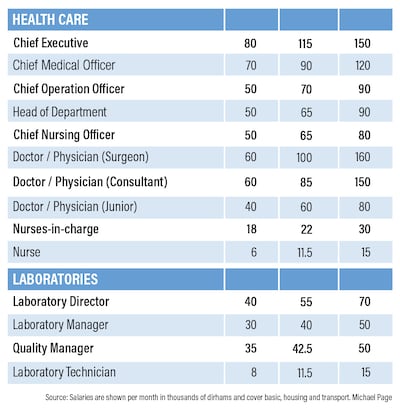
21. What Is the Average
Salary of a Medical Transcriptionist in the Gulf?
This
is one area where applicants need to be careful.
There
is no single official GCC-wide salary scale for medical
transcriptionists.
Pay
varies by:
·
Country
·
City
·
Hospital
·
Employer
·
Experience
·
Specialty
·
Certification
·
Typing speed
·
EHR experience
·
Acute-care experience
·
Shift pattern
·
Employment package
Current
salary-reporting platforms provide useful market indications, but their samples
can be small and should not be treated as official government salary
statistics.
United Arab Emirates
Indeed’s current UAE salary page
reports an average base salary of approximately AED 3,869 per month,
based on 19 reported salaries as of July 3, 2026. Its reported range is
approximately AED 2,090–7,161 per month.
Naukrigulf currently reports an
average of approximately AED 4,418 per month based on 159 salary
submissions, with a reported range of approximately AED 2,222–7,500.
For Dubai, Naukrigulf reports
approximately AED 4,922 per month from 42 reported salaries, while
Indeed reports approximately AED 3,718 per month from a much smaller sample.
Therefore, a reasonable practical
expectation for many UAE medical-transcription positions is approximately:
AED 3,000–6,000+ per month,
with higher compensation possible for experienced or specialized professionals.
Qatar
Naukrigulf reports medical-transcription salaries in
Qatar in the approximate range of QAR 2,800–9,600 per month, with an
average around QAR 4,650–5,683 depending on the experience grouping used.
A 2026 recruitment listing for a
medical-transcription position associated with Hamad Medical Corporation
advertised approximately QAR 5,100 per month and required two years of
experience.
Saudi Arabia
Naukrigulf currently reports an approximate
monthly range of SAR 2,160–3,240 for its limited medical-transcription
sample.
However, the sample is very small, so
applicants should not treat this as a definitive Saudi salary scale.
Oman
Naukrigulf’s current data show approximately OMR
196–295 per month, again based on a very small number of reported salaries.
The important conclusion
Salary websites should be used as
market indicators rather than promises.
A candidate should always compare
the actual employment offer, including accommodation, transport, insurance,
leave and airfare, rather than looking only at the headline salary.
22. What Benefits Can a
Gulf Medical Transcriptionist Receive?
Benefits
vary dramatically between employers.
Depending
on the employer and employment contract, Gulf healthcare documentation
professionals may receive some combination of:
·
Employment visa sponsorship
·
Medical insurance
·
Annual leave
·
Paid public holidays
·
Airfare or annual
air-ticket allowance
·
Accommodation
·
Housing allowance
·
Transportation
·
Transport allowance
·
End-of-service benefits
·
Overtime
·
Performance incentives
·
Training
·
Career-development
opportunities
Some
current Gulf recruitment advertisements for medical-transcription and related
healthcare-documentation positions explicitly list visa sponsorship,
accommodation, transportation and medical insurance.
However,
these benefits are not guaranteed for every medical transcriptionist.
A
candidate should read the written employment contract carefully.
A
job offering AED 5,000 with accommodation, transport and medical insurance may
be financially more attractive than one offering AED 6,000 without those
benefits.
23. What Do Gulf Employers Look
For?
Current
UAE vacancies provide useful clues.
For
example, current Burjeel recruitment information lists:
·
Bachelor’s degree or
equivalent
·
At least two years’
experience
·
Strong understanding of
medical terminology
for
a Medical Transcriptionist position.
Other
current UAE listings emphasize:
·
Medical terminology
·
EHR/EMR
·
Speech-recognition software
·
Editing
·
Confidentiality
·
Typing speed
·
Medical documentation
·
English communication
·
Attention to detail
This
tells applicants something important:
A
Gulf employer may want a complete documentation professional rather than a
person who merely possesses a transcription certificate.
24. Can a Medical
Transcriptionist Become a Medical Coder?
Absolutely.
In
fact, medical coding is one of the more logical career-development options for
an experienced transcriptionist.
A
transcriptionist already becomes familiar with:
·
Diagnoses
·
Procedures
·
Clinical terminology
·
Medical records
·
Physician documentation
·
EHRs
·
Patient encounters
But
transcription experience alone does not qualify someone as a medical coder.
Additional
education is required in areas such as:
·
ICD-10-CM
·
CPT
·
HCPCS
·
Coding guidelines
·
Medical necessity
·
Compliance
·
Reimbursement
·
Anatomy
·
Pathophysiology
·
Payer requirements
Professional
certifications can include credentials offered by organizations such as:
·
AAPC
·
AHIMA
The
career progression could therefore look like:
Medical
Transcriptionist → Medical Coder → Senior Coder → Coding Auditor → Coding
Specialist
This
can provide a more diversified career path in healthcare information
management.
25. Ten Skills That Can
Make a Medical Transcriptionist More Employable
A
highly employable professional should aim to develop these ten capabilities:
1. Medical terminology
Know the language of healthcare.
2. Anatomy
Understand body structures.
3. Physiology
Understand body functions.
4. English grammar
Produce professional documentation.
5. Typing accuracy
Avoid clinical errors.
6. Listening
Understand dictation accurately.
7. Research
Know how to verify unfamiliar information.
8. EHR/EMR
Understand electronic healthcare documentation.
9. Confidentiality
Protect patient information.
10. AI literacy
Understand how AI-generated clinical
documentation is produced, reviewed and corrected.
The tenth skill may become increasingly
important over the next decade.
26. Is the Gulf a Good
Destination for This Career?
The
answer is:
Potentially,
particularly for experienced professionals with strong documentation and EHR
skills.
Current
UAE vacancies demonstrate that medical-transcription positions continue to
exist.
Burjeel
Holdings currently advertises Medical Transcriptionist opportunities requiring
a bachelor’s degree or equivalent, experience and strong medical-terminology
knowledge.
NMC
Healthcare and other UAE healthcare organizations have also advertised
medical-transcription roles involving review and editing of dictated material,
spelling, grammar, clarity and medical terminology.
Qatar
also has current/recent market evidence for medical transcription, including
positions requiring experience and medical-transcription training.
But
the Gulf should not be viewed as a market where simply obtaining a certificate
guarantees employment.
Competition
exists.
Employers
often prefer:
qualification
+ experience + EHR + accuracy + English + medical knowledge.
27. Final Verdict: Is
Medical Transcription Worth Learning in 2026?
My
answer would be:
Yes — but learn it strategically.
If someone wants a
career consisting exclusively of traditional audio transcription, they should
understand that AI and speech-recognition technologies are reducing demand.
BLS confirms that
traditional medical transcription is projected to decline in the United States.
However, the broader
healthcare-information sector offers stronger long-term prospects.
Medical records
specialists are projected to grow 7%, while health information technologists
and medical registrars are projected to grow 15% from 2024 to 2034.
This creates an
intelligent career strategy:
Enter through
medical transcription.
Then develop additional
skills.
Move toward
healthcare documentation, medical coding, health information management, clinical
documentation, auditing or other digital-health roles.
Conclusion
Medical
transcription may look like a simple occupation from the outside.
It is not.
A professional
medical transcriptionist combines the skills of a language specialist,
healthcare-information worker, researcher, editor and technology user.
The job requires
excellent listening skills, accurate typing, medical terminology, anatomy,
physiology, pharmacology, English grammar, research ability, attention to
detail and confidentiality.
Modern transcription
also requires EHR/EMR knowledge and familiarity with speech-recognition and
AI-assisted documentation.
For people
considering a career in the Gulf, professional preparation should go beyond
obtaining a certificate.
A stronger pathway
is:
English → Medical
Terminology → Anatomy & Physiology → Transcription → EHR/EMR → Speech
Recognition → RHDS → Hospital Experience → Gulf Employment → CHDS / Coding /
HIM / Clinical Documentation
The Gulf market can
offer opportunities in the UAE, Saudi Arabia, Qatar, Oman, Bahrain and Kuwait,
but salaries and benefits vary considerably between employers.
In the UAE, current
salary-reporting data place the average medical-transcription salary roughly
around AED 3,800–4,400 per month, although actual offers may be lower or
considerably higher depending on experience, employer and benefits.
Qatar salary data
suggest a broad range, with current reports generally placing many positions
around QAR 4,000–6,000 per month, although sample sizes are limited.
Employment packages
may include medical insurance, visa sponsorship, accommodation, transportation
and annual leave, but these benefits should never be assumed and must be
verified in the employment contract.
Finally, AI should
not be viewed only as a threat.
It can be viewed as
a reason to upgrade.
The professional who
insists on doing everything manually may struggle.
The professional who
understands medical language, EHRs, documentation quality and how to review
and correct AI-generated clinical documentation may have a much stronger
future.
The medical
transcriptionist of tomorrow may therefore not spend all day typing.
They may spend their
day checking, editing, validating, auditing and improving the work of
machines.
And that could make
healthcare documentation a much broader career than traditional transcription
ever was.
About the Author
Mohammad
Ali
Former Medical Secretary, Burjeel Medical
City, Abu Dhabi, UAE
Mohammad Ali is a healthcare professional
with experience in the medical administration and healthcare environment in Abu
Dhabi, UAE. His professional interests include healthcare careers, medical
administration, healthcare documentation, employment opportunities and
professional development for healthcare professionals seeking opportunities in
the Gulf and Middle East.
Author Photograph
References and Original Sources
1. U.S. Bureau of Labor
Statistics — Medical Transcriptionists
BLS occupational
data covering duties, education, salary, employment and the 2024–2034 outlook.
urlU.S. Bureau
of Labor Statistics — Medical Transcriptioniststurn1search0
2. U.S. Bureau of Labor
Statistics — Health Information Technologists and Medical Registrars
Useful for
understanding the broader and potentially faster-growing healthcare-information
career field.
urlBLS — Health
Information Technologists and Medical Registrarsturn1search1
3. U.S. Bureau of Labor
Statistics — Medical Records Specialists
Relevant to the
potential career progression from transcription into health information and
coding-related work.
urlBLS —
Medical Records Specialiststurn1search8
4. O*NET OnLine — Medical
Transcriptionists
Official U.S.
occupational information describing transcription, editing, medical terminology
and related professional duties.
urlO*NET OnLine —
Medical Transcriptioniststurn0search17
5. Association for Healthcare
Documentation Integrity — Approved Programs
Current AHDI
directory of approved healthcare-documentation education programs.
urlAHDI — Find
an Approved Programturn0search11
6. AHDI — Healthcare
Documentation Specialist FAQs
Information about
training duration, the Model Curriculum and the recommended 100-hour
professional-practice component.
urlAHDI — HDS
FAQsturn1search13
7. AHDI — RHDS Examination
Current eligibility,
online-proctored examination procedure and RHDS fees.
urlAHDI — RHDS
Examinationturn2search0
8. AHDI — CHDS Examination
Current CHDS eligibility/examination
information and fees.
urlAHDI — CHDS
Examinationturn2search1
9. AHDI — Credentialing Candidate Guide
Current credentialing
examination fee information.
urlAHDI —
Credentialing Candidate Guideturn2search6
10. AHDI — Recertification
Current three-year credential cycle
and continuing-education requirements.
urlAHDI —
Recertificationturn1search11
11. Blackstone Career Institute —
Medical Transcription Program
Current tuition,
duration, practicum, curriculum and RHDS preparation.
urlBlackstone —
Medical Transcription Programturn2search4
12. CareerStep — Medical
Transcription Training
Current online
training, duration, curriculum and published tuition.
urlCareerStep —
Medical Transcription Trainingturn2search5
13. NCBI Bookshelf — Medical
Terminology, 2nd Edition
Open educational
resource for medical terminology, anatomy-related terminology and body systems,
available under CC BY 4.0.
urlNCBI
Bookshelf — Medical Terminology, 2nd Editionturn0search6
14. OpenStax — Anatomy and Physiology
2e
Open educational
resource for anatomy and physiology.
urlOpenStax — Anatomy
and Physiology 2eturn0search8
15. Indeed — UAE Medical
Transcriptionist Salary
Current UAE
salary information and reported salary range.
urlIndeed —
Medical Transcriptionist Salary in UAEturn3search2
16. Naukrigulf — UAE Medical
Transcriptionist Salary
Current salary
information based on reported salaries.
urlNaukrigulf —
Medical Transcriptionist Salary in UAEturn3search9
17. Naukrigulf — Dubai Medical
Transcriptionist Salary
Current Dubai
salary information and experience breakdown.
urlNaukrigulf —
Medical Transcriptionist Salary in Dubaiturn3search5
18. Naukrigulf — Qatar Medical
Transcriptionist Salary
Current Qatar
salary information.
urlNaukrigulf —
Medical Transcriptionist Salary in Qatarturn3search4
19. UAE Medical Transcriptionist
Recruitment Evidence
Current/recent
UAE vacancy information demonstrating employer requirements including medical
terminology, EHR, typing and confidentiality.
20. Recent AI Clinical
Documentation Research
A randomized
clinical trial evaluated ambient AI scribes across 238 physicians and 14
specialties, examining documentation time and related outcomes.
urlPubMed —
Ambient AI Scribes in Clinical Practiceturn0search15
Important Salary Disclaimer
Salary
figures in this article are market estimates and reported salary data, not
guaranteed employment offers. Salary-reporting platforms can have different
methodologies and sample sizes. Gulf compensation should always be evaluated
together with accommodation, transport, health insurance, airfare, leave,
overtime, bonuses and other contractual benefits.
Likewise,
professional certification, visa eligibility and employer requirements can vary
by country and organization. Candidates should verify the latest requirements
directly with the relevant employer, certification body and government
authority before paying fees or accepting employment.




 Posts
Posts


