

Educational Disclaimer: The information and dynamic tools published on this page are provided exclusively for educational, guidance, and career planning purposes to assist medical professionals navigating Gulf Cooperation Council (GCC) credentialing processes.
Government Non-Affiliation Notice: Gulf Care Careers is an independent educational portal. We are not associated, affiliated, authorized, endorsed by, or in any way officially connected with the Ministry of Health - Saudi Arabia, the Saudi Commission for Health Specialties (SCFHS), Dubai Health Authority (DHA), Department of Health Abu Dhabi (DOH/HAAD), Ministry of Health and Prevention UAE (MOHAP), Qatar Council for Healthcare Practitioners (QCHP), or any other government licensing board or health authority in the Gulf region.
Notice on Policy Updates: Healthcare licensing regulations and Primary Source Verification (PSV) procedures change periodically. While our editorial team audits all guidelines against active 2026 GCC decrees, applicants should verify requirements on official government portals.
 |
| Gulf Care Careers logo |
 |
| Step-by-Step Dubai Health Authority (DHA) Licensing & Prometric Exam Roadmap for Nurses, Doctors, and Allied Health Staff. |
Step-by-Step Guide to Passing the DHA Exam for Nurses in 2026
Published by Gulf Care Careers
Revised: 23rd Sep, 2026.
If you're planning to work as a Registered Nurse in Dubai, passing the Dubai Health Authority (DHA) Prometric Exam is one of the most important steps toward obtaining your professional license. Every year, thousands of nurses from around the world apply for DHA eligibility, but many are unsure where to begin.
This comprehensive guide walks you through the DHA licensing process, exam preparation tips, and common mistakes to avoid in 2026.
What Is the DHA Exam?
The Dubai Health Authority (DHA) licensing examination is a computer-based assessment administered through Prometric. It evaluates whether nurses possess the clinical knowledge and professional competence required to practice safely in Dubai's healthcare sector.
Passing the exam is a key requirement for obtaining DHA Eligibility and applying for nursing positions in hospitals, clinics, and healthcare centers across Dubai.
Who Can Apply?
Eligibility requirements may vary depending on your nursing category and DHA's current regulations, but applicants generally need:
- A recognized nursing qualification.
- A valid nursing registration or license from their home country (where applicable).
- Relevant professional experience, if required under current DHA criteria.
- A valid passport.
Always verify the latest eligibility criteria through the official DHA licensing authority before applying.
Step 1: Create Your Professional Account
Begin by registering on the official DHA licensing portal.
You will create your professional profile and upload the required documentation.
Typical documents include:
- Passport copy
- Passport-size photograph
- Nursing diploma or degree
- Academic transcripts
- Professional nursing license
- Experience certificates (if applicable)
Ensure that all documents are clear, valid, and consistent. Differences in names, dates, or qualifications can delay your application.
Step 2: Complete Primary Source Verification (DataFlow)
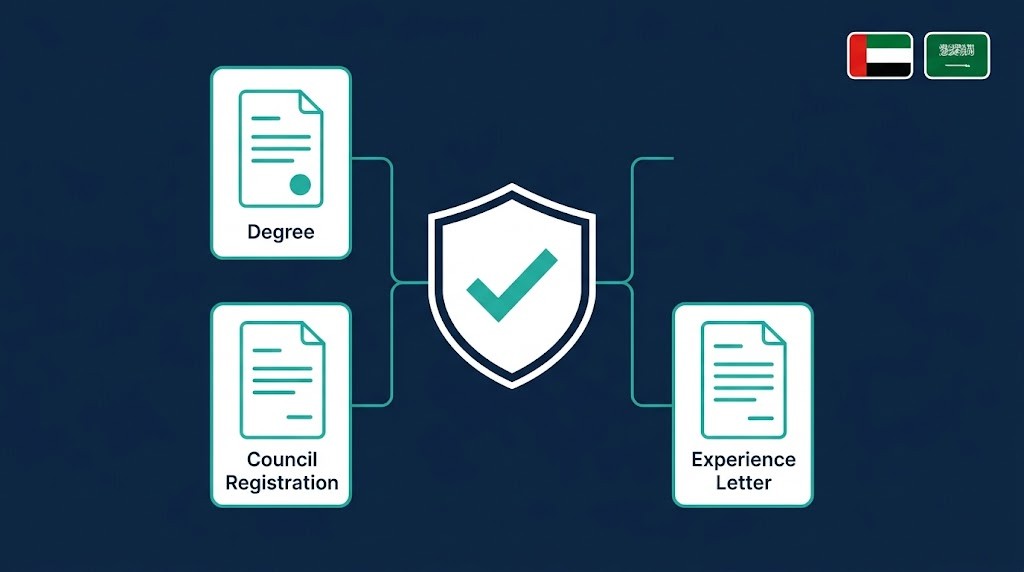
Before you can proceed to the examination, your educational qualifications, professional license, and experience documents may need to undergo Primary Source Verification (PSV) through the approved verification process.
Verification confirms that your credentials are authentic.
Incomplete or inaccurate documentation can significantly delay licensing.
Step 3: Receive Eligibility to Book the Exam
Once your documents have been assessed and accepted according to the licensing process, you'll be able to schedule your examination through the authorized testing provider.
Choose a testing center and examination date that gives you sufficient preparation time.
Step 4: Understand the Exam Format
Although the exact content may change over time, the DHA nursing examination generally evaluates knowledge in areas such as:
- Medical-Surgical Nursing
- Adult Health Nursing
- Pediatric Nursing
- Maternal and Newborn Care
- Pharmacology
- Infection Prevention and Control
- Patient Safety
- Nursing Ethics
- Emergency Nursing
- Mental Health Nursing
- Leadership and Professional Practice
Questions are multiple-choice and are designed to assess clinical judgment as well as theoretical knowledge.
Step 5: Create a Study Plan
Successful candidates usually prepare consistently over several weeks rather than relying on last-minute revision.
A sample eight-week plan:
Weeks 1–2
- Medical-Surgical Nursing
- Anatomy and Physiology
- Pharmacology
Weeks 3–4
- Pediatric Nursing
- Obstetrics and Gynecology
- Infection Control
Weeks 5–6
- Emergency Nursing
- Critical Care
- Nursing Ethics
- Patient Safety
Weeks 7–8
- Practice questions
- Mock examinations
- Weak-topic revision
Study for approximately 2–3 focused hours daily, adjusting your schedule to fit your experience and availability.
Step 6: Practice Questions Every Day
Reading alone is not enough.
Daily practice helps you:
- Improve speed.
- Understand question patterns.
- Strengthen clinical decision-making.
- Build confidence before exam day.
Review explanations for both correct and incorrect answers to reinforce learning.
Step 7: Focus on Patient Safety
Many licensing examinations emphasize safe clinical practice.
Be comfortable with topics such as:
- Medication administration
- Infection prevention
- Patient identification
- Fall prevention
- Documentation
- Communication
- Ethical practice
These concepts are fundamental to nursing care.
Step 8: Strengthen Pharmacology Knowledge
Many candidates find pharmacology challenging.
Review:
- Drug classifications
- Common indications
- Contraindications
- Side effects
- Safe medication calculations
- High-alert medications
Understanding principles is generally more useful than memorizing long lists of drug names.
Step 9: Learn Clinical Prioritization
Licensing exams often assess how nurses prioritize patient care.
Practice identifying:
- The patient requiring immediate attention.
- Signs of clinical deterioration.
- Appropriate nursing interventions.
- Escalation of care.
Use structured thinking and apply nursing process principles.
Step 10: Prepare for Exam Day
Before leaving for the testing center:
- Bring valid identification.
- Arrive early.
- Get adequate sleep the night before.
- Eat a balanced meal.
- Stay calm and manage your time during the exam.
If you encounter a difficult question, move on and return to it later if time permits.
Common Mistakes to Avoid
Many candidates lose valuable marks because they:
- Rush through questions.
- Ignore key words such as first, best, priority, or most appropriate.
- Spend too much time on one question.
- Neglect infection control principles.
- Skip regular practice tests.
Careful reading and steady pacing can make a significant difference.
Recommended Study Resources
High-quality study materials include:
- Current nursing textbooks.
- NCLEX-RN review resources (for foundational nursing concepts).
- Drug reference guides.
- Practice question banks.
- Official guidance published by the relevant licensing authority.
Always ensure your resources are up to date.
Frequently Asked Questions (FAQs)
Is the DHA nursing exam difficult?
The exam is considered manageable for candidates with a solid understanding of nursing fundamentals who prepare consistently using current study materials.
How long should I prepare?
Preparation time varies, but many candidates benefit from several weeks of structured study combined with regular practice questions.
Can I apply for jobs before taking the exam?
Some employers may consider applicants who are in the licensing process, while others prefer candidates who have already obtained DHA Eligibility. Requirements vary by employer.
Is passing the exam enough to work in Dubai?
Passing the examination is one step in the licensing process. You must also satisfy all applicable licensing requirements and complete any remaining procedures required by the Dubai Health Authority before practicing.
Final Thoughts
Passing the DHA Exam is an important milestone toward a nursing career in Dubai. Success depends on consistent preparation, strong clinical knowledge, and careful attention to the licensing process.
Focus on understanding nursing concepts, practice regularly, and verify that all your documents meet current licensing requirements. With preparation and persistence, you'll be well positioned to pursue rewarding opportunities in Dubai's healthcare sector.
Disclaimer: This article is provided for general informational purposes only and should not be considered official licensing advice. DHA licensing policies, eligibility criteria, examination content, and procedures may change over time. Applicants should always consult the official Dubai Health Authority licensing resources for the most current information before applying.
Author:
Mr. Mohammad Ali
Former Medical Secretary & Healthcare Licensing Officer,
Burjeel Medical City
Abu Dhabi, UAE
Connect with Mohammad Ali on LinkedIn (https://www.linkedin.com/in/mrmuhammadali)
Medical Reviewer:
Dr. Kevin Joseph Jerome Borges,
Doctor of Medicine, Professor of Anatomy,
Ziauddin Medical University,
Karachi, Pakistan
Connect with Mohammad Ali on LinkedIn (https://www.linkedin.com/in/kevin-borges-a86049121)




 Posts
Posts


